















Mass Readings
Catholic Ireland
Liturgical Readings for : Wednesday, 24th June, 2026Léachtaí Gaeilge
Next Sunday's Readings
24/6, The Nativity of St John the Baptist, Solemnity
John was a man of self-denial and integrity and a uncompromising prophetic voice.
Feast of the Day: 24 June; Nativity of St John the Baptist
C/f A short life of this saint can be found below todays’ Readings and Reflection.
FIRST READING
A reading from the first book of the Prophet Isaiah 49:1-6
I will make you the light of the nations so that my salvation may reach to the ends of the earth.
‘Islands, listen to me, pay attention, remotest peoples. The Lord called me before I was born, from my mother’s womb he pronounced my name.
 He made my mouth a sharp sword, and hid me in the shadow of his hand.
He made me into a sharpened arrow, and concealed me in his quiver.
He said to me, ‘You are my servant (Israel) in whom I shall be glorified.’
while I was thinking, ‘I have toiled in vain, I have exhausted myself for nothing.’
And all the while my cause was with the Lord, my reward was with my God.
I was honoured in the eyes of the Lord, my God was my strength.
And now the Lord has spoken, he who formed me in the womb to be his servant, to bring Jacob back to him, to gather Israel to him:
‘It is not enough for you to be my servant, to restore the tribes of Jacob and bring back the survivors of Israel; I will make you the light of the nations so that my salvation may reach to the ends of the earth.’
The Word of the Lord. Thanks be to God.
Responsorial Psalm Ps 138
Response I thank you for the wonder of my being.
1. O Lord, you search me and you know me, you know my resting and my rising,
you discern my purpose from afar.
You mark when I walk or lie down, all my ways lie open to you. Response
2. For it was you who created my being, knit me together in my mother’s womb.
I thank you for the wonder of my being, for the wonders of all your creation. Response
3. Already you knew my soul, my body held no secret from you
when I was being fashioned in secret and moulded in the depths of the earth. Response
SECOND READING
A reading from the Acts of the Apostles 13:22-26
Jesus whose coming was heralded by John.
Paul said: ‘God made David their king, of whom he approved in these words,
“I have selected David son of Jesse, a man after my own heart, who will carry out my whole purpose.“
To keep his promise, God has raised up for Israel one of David’s descendants, Jesus, as Saviour, whose coming was heralded by John when he proclaimed a baptism of repentance for the whole people of Israel.
Before John ended his career he said, “I am not the one you imagine me to be; that one is coming after me and I am not fit to undo his sandal.” ‘My brothers, sons of Abraham’s race, and all you who fear God, this message of salvation is meant for you.’
The Word of the Lord. Thanks be to God.
Gospel Acclamation Lk 1: 76
Alleluia, alleluia!
As for you, little child, you shall be called Prophet of the Most High.
You will go ahead of the Lord to prepare the way for him..
Alleluia!
GOSPEL
The Lord be with you. And with your spirit
A reading from the holy Gospel according to Luke 1:57-66. 80 Glory to you, O Lord.
His name is John.
The time came for Elizabeth to have her child, and she gave birth to a son; and when her neighbours and relations heard that the Lord had shown her so great a kindness, they shared her joy.
Now on the eighth day they came to circumcise the child;
they were going to call him Zechariah after his father, but his mother spoke up. ‘No,’ she said ‘he is to be called John.‘
They said to her, ‘But no one in your family has that name’, and made signs to his father to find out what he wanted him called.
The father asked for a writing-tablet and wrote, ‘His name is John.‘
And they were all astonished. At that instant his power of speech returned and he spoke and praised God. All their neighbours were filled with awe and the whole affair was talked about throughout the hill country of Judaea. All those who heard of it treasured it in their hearts.
‘What will this child turn out to be?‘ they wondered. And indeed the hand of the Lord was with him.
Meanwhile the child grew up and his spirit matured. And he lived out in the wilderness until the day he appeared openly to Israel.
The Gospel of the Lord. Praise to you, Lord Jesus Christ.
*********************
Gospel Reflection 24/6 The Nativity of John the Baptist Luke 1:57-66, 80
Who gets to name a new born child? Today we would presume it was the child’s parents who made that decision. In the time and place of Jesus, the naming of a child was more of a decision of the wider family and community, rather than a decision just for the parents. In today’s gospel reading, the neighbours and relations seem to have decided that Elizabeth’s child would be called Zechariah after his father.
However, the child’s mother stood up against this consensus, declaring that he would be called John, after the name given to him by the angel Gabriel at the annunciation of the child’s birth to Zechariah. The wider family and community were stunned, ‘no one in your family has that name’. Zechariah, who had been rendered dumb for doubting the promise made by Gabriel, confirmed in writing that his child would be called John.
A new beginning in God’s dealings with his people called for a new name, a name that conveyed the nature of this new beginning. Many Hebrew names have a religious meaning and the name ‘John’ means ‘God is gracious’. The child of Elizabeth and Zechariah would announce the coming of someone who would reveal God’s gracious love in a powerfully new way. According to the gospel reading, people were asking, ‘What will this child turn out to be?’ He turned out to be the adult that God wanted him to be, the one who witnessed to the arrival of God’s special messenger to humanity and who prepared people to welcome this messenger by calling on them to be baptized. John would lead people to Jesus, God’s gracious gift to all. On this feast of his birthday, we might give thanks for all those people in our lives who have led us to Jesus and have helped us to see him more clearly.
________________________________
The Scripture Readings are taken from The Jerusalem Bible, published 1966 by Darton, Longman & Todd Ltd. and used with the permission of the publishers. http://dltbooks.com/
The Scripture Reflection is made available with our thanks from his book Reflections on the Weekday Readings; : The Word is near to you, on your lips and in your heart by Martin Hogan and published by Messenger Publications c/f www.messenger.ie/bookshop/
_________________
Feast of the Day: June 24: The Birth of John the Baptist
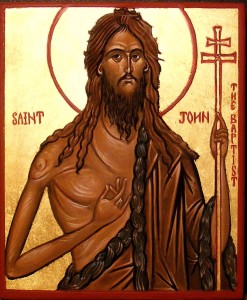
This feast was observed on this date from the fourth century. It celebrates the birth of “the greatest of all the prophets, ” the one who leapt for joy in his mother’s womb, who prepared the way for, announced his presence of, and baptised Jesus in the Jordan River – And how we in Ireland, commemorate it!
 As the feast of Christmas christianised the celebration of the winter solstice with the theme of the “unconquered sun“, so it would seem does the feast of the birth of John the Baptist – six months earlier – Christianise the summer solstice celebration from traditional religions. Celtic folklore associated the themes of fire and water with this feast.
Patrick Duffy explains the origins and later Irish connections.
Emergence of the feast in the early 5th century
Three factors seem to have influenced the emergence of this feast in the early fifth century.
The first is probably the emergence in the early fourth century of the feast of Christmas.
The second is the verse of Luke gospel where the angel tells Mary at the annunciation that “her kinswoman Elizabeth already in her old age and considered barren is now in her sixth month, for nothing is impossible with God” (Lk 1:37).
The third is that three authorities from the 5th and 6th centuries – St Augustine (354-430), the Martyrology of Jerome and the Calendar of Carthage – all emphasise that this feast celebrates John’s earthly birthday, and not (as was customary with martyrs) the day of their death,(or their birthday into heaven : dies natalis). It is one of very few feasts left in the Roman Calendar that have a vigil liturgy.
 St John’s fire; summer solstice in Irish folklore
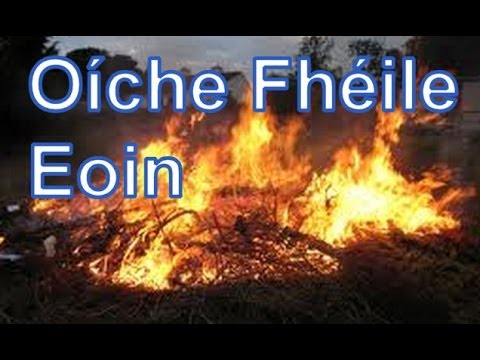
There are many indications in Irish folklore that this feast, Féile Naomh Eoin, was until recently the occasion for a wide range of ritual practices and merrymaking beginning on the previous evening – St John’s Eve. This was Oíche an Tine Chnáimh, “bonfire night”, or Tine Féile Eoin, “St John’s fire“. A similar feast with similar summer solstice themes called the ‘Ivan’ Kupala Day is celebrated in Poland, Russia, Lithuania, Belarus and Ukraine.
In Ireland the tradition was that all the people of the locality – from the smallest children to the oldest men and women – would gather around the fire which was prepared from weeds in the fields. As the sun set, an elder would light the fire with the traditional prayer: “In the honour of God and St. John, to the fruitfulness and profit of our planting and our work, in the the name of the Father and of the Son and of the Holy Spirit. Amen.”
People would throw more weeds into the fire to ensure they would not grow in the fields, and ashes from the fire would be scattered on crops the following day to ensure fertility. Women prayed for good weather and God’s blessing on the crops of the fields. Neglect in this respect might lead to a bad harvest or poor fishing! Later there would be music and dancing.
Jumping Through the Flames
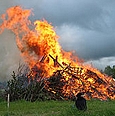 When the musicians struck up, young men asked their partners to dance. In-between sets, songs were sung, stories told, and soloists – musician or dancer – demonstrated their talents.
When the fire would be well ablaze, people would leap through the flames for luck in a new venture, for marriage, when trying for a baby, for good health and for self-purification. In many places, a young woman and man would join hands and jump together. Often, this was nothing more than a mere flirtation, but onlookers surmised at intentions of marriage between the couple. Some would hazard a prediction on the outcome of such a union by the way the flames flickered as they jumped! (We do not recommend these practises nowadays: health and safety issues!)
Rationalisation and Additional Customs
*People rationalised the fire ritual by claiming St John the Baptist was burnt alive, but in fact the Gospels tell us that King Herod had him beheaded.
*Another custom at this time was to gather the herb known as St John’s wort (Hypericum perforatum) used for a wide range of medicinal purposes and popular today for the relief of depression and stress-related illnesses.
*There were also many holy wells dedicated to St John around the country at which pilgrimages and “patterns” would be held on his feast day and which were believed to bring many cures.
******************************
Memorable Sayings for Today
John the Baptist pointed to Jesus and said
“Behold the Lamb of God, the One who takes away the sins of the world.”
~c/f John 1:29 ~
******************************