















29th June 2025
Ss Peter and Paul, Apostles
Gospel reading : Matthew 16:13-19
v 13. When Jesus came to the region of Caesarea Philippi he put this question to his disciples,
‘Who do people say the Son of Man is?‘
v 14 And they said, ‘Some say he is John the Baptist, some Elijah, and others Jeremiah or one of the prophets.‘
v 15 ‘But you,’ he said ‘who do you say I am?‘
v 16 Then Simon Peter spoke up, ‘You are the Christ,’ he said ‘the Son of the living God.‘
v 17 Jesus replied, ‘Simon son of Jonah, you are a happy man!
Because it was not flesh and blood that revealed this to you but my Father in heaven.
v 18 So I now say to you: You are Peter and on this rock I will build my Church. And the gates of the underworld can never overpower it.
v 19 I will give you the keys of the kingdom of heaven: whatever you bind on earth shall be considered bound in heaven; whatever you loose on earth shall be considered loosed in heaven.’
Today we offer two approaches to this feastday
1. by Paddy Duffy
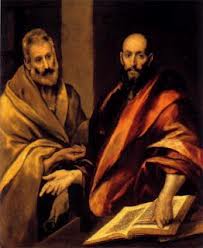 Today is the Solemnity of Ss Peter and Paul, twin founders of the Church in Rome. This was the day traditionally considered in pagan Rome to be its foundation day by Romulus. We celebrate it as the day the twin founders of the Church in Rome.
Peter was a fisherman of Galilee where as he was known as Simon was made the leader of the Apostles by Jesus, died by crucifixion in Rome around the year 64. Simon Peter was a bit of a bungler. Is there then an irony that is providential in Jesus’ choice of him as the leader of the campaign and of the community he put together to bring his salvation to the world. His mission is implied in the new name that Jesus gave him, Cephas meaning ‘Rock.’
Paul, or as he was originally named Saul, on the other hand, was a hugely dedicated Pharisee. His conversion occurred while he on the road to Damascus to hunt down, arrest and punish lapsed Jews (His conversion story is celebrated on 25th January. (c/f Acts 22:3-16 ). He himself became a devout follower of Jesus and later began his life as ‘the Apostle to the Gentiles’. He was beheaded around the year 67. During his early days as a christian Paul had occasion to stand up to Peter because he would not eat with Gentiles – ‘I opposed him to his face, since he was manifestly in the wrong‘ (Gal 2:11) – Both Peter and Paul grew to respect each other and they are both jointly honoured on this feast.
This is now the traditional day when the Pope confers the pallium on all the archbishops whom he has appointed in the previous year. (In the image above Peter and Paul are shown exchanging – the haspasmos.)
The name, Simon who is called Peter’, appears at the top of every list of the apostles in the gospels. When Jesus asked, ‘Who do you say I am?’ Simon made the supreme confession of faith – ‘You are the Christ,’ he said, ‘the son of the living God‘ (Mt 10:2-4 and 16:15-16).
Impulsive and enthusiastic
In character, Peter was impulsive and enthusiastic e.g. wanting to make three tents at the transfiguration on the mountain (Mt 17:4), attempting to walk on the waters and then has to be rescued by Jesus when he begins to sink (Mt 14:29-31). He denying Jesus three times when Jesus was arrested , as Jesus had foretold he would (Mt 26:69-75).
Reinstated and mission
Jesus, however, takes special care to reinstate Peter as leader after the resurrection, asking him three times “Do you love me?” and telling him, “Feed my sheep” (Jn 21:15-17). Thus consolidating Peter in his position as leader of the apostles. The mysterious and providential character of Peter’s (and perhaps everybody’s) life comes out in the words Jesus then spoke according to John’s gospel:
I tell you most solemnly, when you were young
you put on your own belt and walked where you liked;
but when you grow old, you will stretch out your hands
and somebody else will put a belt round you
and take you where you would rather not go (Jn 21:18).
Pentecost, imprisonment and escape
At Pentecost Peter surprised the people in Jerusalem with the power of the words he spoke about Jesus’s resurrection (Acts 2:40-41). Later he was imprisoned by Herod Agrippa, but had a miraculous escape (Acts 12:1-11).
Opposed by Paul
At Antioch, however, Peter gave into racial prejudice, declining to eat with the pagans, but Paul boldly corrected him. He tells us: ‘I opposed him to his face, since he was manifestly in the wrong’ (Gal 2:11). Both Peter and Paul proclaimed with their lives that Jesus is the Christ, and is the Son of God
Death and Memory
Tradition has it that Peter came to Rome and was martyred under Nero around 64 AD, blaming the Christians for burning the city of Rome.
The emperor Constantine built a basilica to house his tomb. The present (16th century) Basilica of St Peter is now on that same site. Twentieth century excavations discovered the tomb of Peter, though it is impossible to prove the bones are his.
According to tradition and recent archaeological research, Peter’s remains, a victim of Nero’s ambitions, rests beneath the high altar in the Basilica of St Peter which bears his name. (See images below)
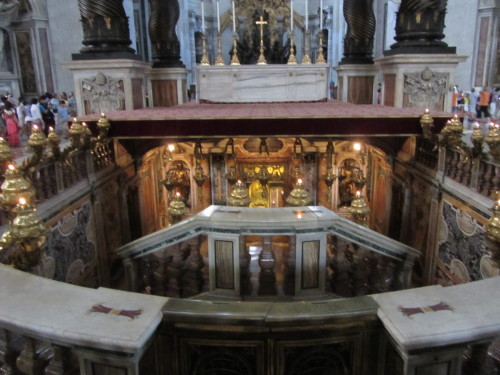
The tomb of St Peter the Apostle in Saint Peters Basilica Vatican City Rome Italy
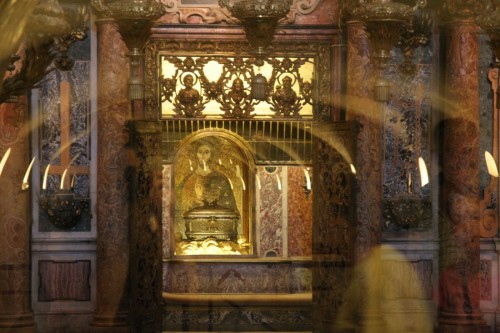
St Peter’ s final resting place
A Petrine ministry
Today in ecumenical circles there is a growing sense that the seminal text of Matt 16:13-19 where Jesus gives Peter authority to bind and loose can and should be interpreted in the sense of a ‘Petrine ministry of leadership and stability in the Church.’ Peter is the chief steward in the palace of the kingdom with a role of rescuing us from death’s dominion.
*******************************************************
2. Fr John Murray PP profiles St Peter .
P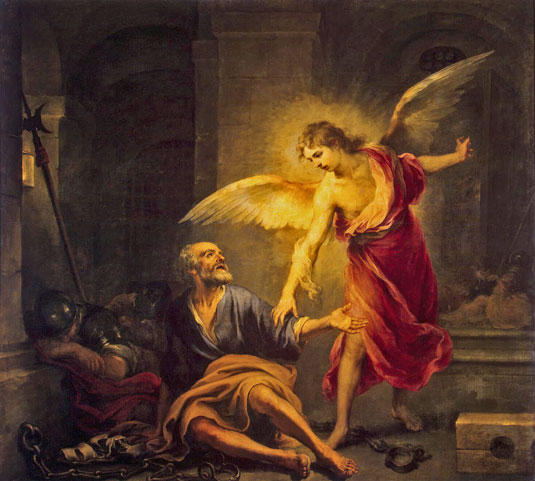 eter is a very attractive figure since he shared our weakness, but after the resurrection he became the one to strengthen his brothers.
(The image left shows St Peter in Prison visited by an angel.)
Tu es Petrus – ‘You are Peter and on this rock I will build my Church.‘
The words in Latin stand five feet high in the lofty vaults of St Peter’s Basilica in Rome. The neck and eye must swivel almost vertically to pick out the scripture verses in golden lettering that speak about Peter’s role within the Church, ‘Feed my lambs, feed my sheep’ and about his humanity, ‘and when you have recovered you shall strengthen your brothers’ (Lk 22:32).
Our present Holy Father, Pope Francis is fulfilling this vicarious role today
Saints and Sinners
Who is ‘Peter’? Through the centuries the papacy has developed and changed. Sadly the post has been held by a few rogues, quite a few men who were more suited to the world of politics than the realm of the spirit, but also, thankfully, by many saints.
In the early formative years of the Church when other centres of faith occasionally fell into heresy, Rome and its bishop never did. Through two millennia that consistency has continued despite sometimes the behaviour of the see’s incumbent. The words of Jesus to Peter have indeed come true: ‘And when you have recovered you will strengthen your brothers’.
Peter is indeed the ‘rock’ on which the Church is built. Yet what is that rock except that profession of faith which each of us is called to make in Jesus, ‘You are the Christ, the Son of the living God.’ While the other disciples gave the opinions of others about the identity of Jesus, Peter stepped out in faith and proclaimed who Jesus really was.
Best friend
One year Pope John Paul II, was visiting a parish in Rome as part of his duties as Bishop of that city. After celebrating Mass with the parishioners he met with the youth of the parish in a time of dialogue and exchange. The young people had the opportunity to ask the Pope questions many of us would love to ask – about his growing up in Poland: Did he have a girlfriend? What football team he supported? And so on. One young man asked him: ‘Who is your best friend?’
Are we surprised that his answer was ‘Jesus Christ’? ‘
The same, I’m sure, would be true of Our present Holy Father, Pope Francis
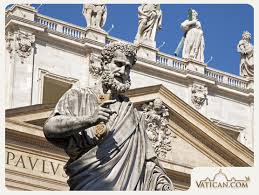
St Simon Peter – The Rock
Quo vadis?
I began these thoughts with the Latin phrase Tu es Petrus. I will end with another, Quo vadis? (‘Where are you going?’).
The legend is that about 64 AD Peter was persuaded by the Christian community in Rome to flee the savage persecution unleashed by the mad Emperor, Nero. ‘It would not be good if our leaders were captured,’ they argued. On the road to Naples and the South, the famous Via Appia, a few miles south of the city Peter met a man. who asked him ‘Quo vadis?’ he asked him.
The legend continues Peter turned on spot and began walking back into Rome. ‘I am going to Rome to be crucified,‘ was the reply. Peter knew it was the Lord and turned on his heel and walked back to the city to share the fate of Jesus and his brothers and sisters .
3 Fr Martin Hogan, Dublin Diocese Ss Peter and Paul
Peter and Paul were two very different people who on at least one important issue in the early church were seriously at odds with one another. Peter wanted pagans who entered the church to submit to the Jewish Law, whereas Paul insisted that this was an unnecessary imposition on them.
Peter Vs Paul
Peter was a fisherman from Galilee, a predominately rural area.
Paul was from the university city of Tarsus, in the south of modern day Turkey.
Peter was an Aramaic speaking Jew;
Paul was a Greek speaking Jew.
Peter probably just had the very basic education of his time and place;
Paul was clearly a very well educated and literate person.
Peter, of course, knew Jesus personally and was with him throughout his public ministry.
Paul only ever encountered the risen Lord.
Peter’s mission was primarily to preach the gospel to the Jews.
Paul’s mission was to preach the gospel primarily to pagans.
According to Paul, in his letter to the Galatians, he met Peter for the first time in the city of Jerusalem, some three years after the risen Lord appeared to Paul,
‘after three years, I did go up to Jerusalem to visit Cephas and stayed with him fifteen days’. No doubt, on that occasion, Peter had an opportunity to share with Paul his own experiences of Jesus during his public ministry. In spite of their many differences, they were both equally dedicated to serving the Lord.
In the first reading for today, Peter was imprisoned for his work of preaching the gospel.
In the second reading Paul speaks as one who is already ‘being poured away as a libation’, a drink offering in the Temple. They were each put to death because of their faith in Christ during the persecution of the church in Rome ordered by Nero, who it is said, blamed the Christians of Rome for the great fire in the city.
The Lord worked very differently but very powerfully through each of them. The Lord wishes to work through each of us and will do so in a way that is unique to each of us. The Lord needs diversity, not uniformity. Yet, he needs us to work in harmony, like the different parts of one body. Sometimes our diversity can cause tension, as sometimes happened between Peter and Paul, but such tension can be healthy and can ultimately serve the Lord’s purposes. Our tensions can be resolved if, like Peter and Paul, we keep our eyes fixed on the risen Lord whose servants we are.
****************************************