















Saint of the Day
 Summary: St Margaret Clitherow, a young English mother and martyr, was among the forty English martyrs canonised by Pope Paul VI in 1970.
Paul Hurley SVD tells her story.
Some people complain that Pope John Paul II canonised too many saints. How many are too many? During his 26-year reign he named 482 saints, more than all those canonised by the 50 previous popes in the last 500 years. But unlike these European saints, mainly priests and nuns, most of John Paul’s 482 were Asian lay people and nearly 84 per cent were martyrs – 120 Chinese, 117 Vietnamese and 103 Koreans. Some of the 81 saints canonised by Pope Paul VI were also martyrs, among them 40 British men and women. One was St Margaret Clitherow, a young married woman.
Margaret’s Story
Born in York in 1556, Margaret was a daughter of Thomas Middleton, a Protestant and prosperous chandler. He died when she was nine, leaving her “one silver goblet and half a dozen silver spoons”. Four months later her mother married Henry May, Lord Mayor of York.
Brought up a Protestant, Margaret, like most middle class girls at the time, learned housekeeping but not to read and write. At 15 she married John Clitherow, a widower with several children. Kind and easygoing, he was also a Protestant, but many of his family were Catholics, among them his brother William, who became a priest. So Margaret soon had many Catholic friends and became a convert herself when she was 18. For a Protestant husband to have a Catholic wife was not uncommon then.
Margaret’s Family
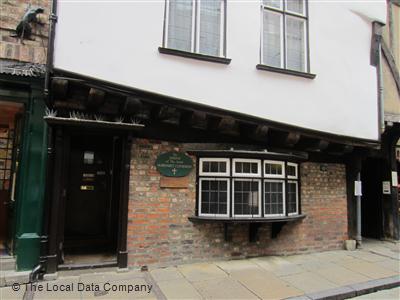 Margaret had three children, two boys and a girl. They lived in Little Shambles, a narrow street in York, where she regularly helped her husband in his butcher’s shop. She was described by Father John Mush, her confessor and first biographer, as good-looking, witty and popular.
Margaret lived during the reign of Queen Elizabeth I, whose Protestant mentors launched a savage persecution of the Catholic Church. Catholics were fined for not attending the new Anglican service and were imprisoned for six months for going to Mass, which was forbidden. Margaret sheltered many priests in her home, which became one of the main Mass centres in York.
Imprisonment
Between 1577 and 1585 she was imprisoned several times; she learned to read and write in prison and her youngest child was born there. Her older children were also imprisoned, even her 12-year-old daughter Anne, who later became a nun. Margaret’s good Protestant husband allowed her to help priests and paid her fines. Her last and longest imprisonment lasted 18 months.
Her Eldest son, Henry, a priest
Shortly after her release in 1585 it was made high treason for an Englishman to be ordained abroad and return home to minister as a priest, as some did. To shelter priests was also made punishable by death. Margaret had already sent her eldest son, Henry, abroad to be educated at Douai, where he was ordained after her death, as was one of her stepsons.
 Treason
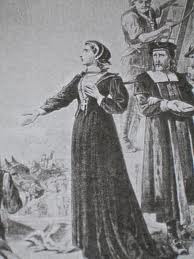
She was arrested on 12 March 1586. Her house was raided and though her children revealed nothing when questioned, a Flemish boy, a guest there, was so frightened under threat of a beating that he disclosed the secret place for celebrating Mass. Margaret was then charged with treason for harbouring priests.
Martyrdom
On 15 March she was condemned to a barbaric death – to be pressed under a heavy board loaded with weights. Judge Clinch said,
“You must be stripped naked, laid down, your back upon the ground, and as much weight laid upon you as you are able to bear, and so continue for three days. On the third day you shall be pressed to death, your hands and feet tied to posts and a sharp stone under your back.” A Protestant minister and others then tried to make her renounce her Catholic faith.
When John Clitherow heard of the sentence, he said,
“Let them take all I have and save my wife, for she is the best wife in all England and the best Catholic also.”
The last part of her savage sentence was carried out on 25th March, the Friday of Passion Week, 1586. Fifteen minutes after an extra load was laid upon her, she was crushed to death. Her last words, cried out in excruciating pain, were,
“Jesu, Jesu, Jesu, have mercy on me.” She was 30 years old.
Her body was left in “the press” for six hours before being buried beside a dunghill. Six weeks later it was found, still incorrupt, by some Catholics and buried with honour.
On this day, her feast day, let us remember the beautiful ‘Pearl of York’.
This article first appeared in The Word (2001), a Divine Word Missionary Publication.
____________________________
******************************
Memorable Saying for Today
A woman of immovable faith in God won’t let anything
stand in her way.
No matter what comes her faith is unstopable
~ Joanne W ~
******************************
Summary: Following in the footsteps of the English missionary St Boniface, Ludger, who was a native Netherlander, as a priest brought the faith to the people of Frisia in Holland and the Saxons of north-west Germany. He was a gentle patient soul.
Patrick Duffy tells his story.
 A Frisian of noble descent
Ludger was born at Zuilen, near Utrecht, in the Netherlands about 742. His parents were wealthy Christian Frisians of noble descent. When he was eleven years of age, he saw the English missionary St Boniface and this made such an impression on him that he became a disciple of St Gregory of Utrecht (friend of St Boniface). He later wrote a Life of St Gregory. He then went to England to study under Alcuin at York for some years (767-771). While there he developed a friendship with Alcuin which lasted through life and was ordained a deacon.
Difficulties preaching the gospel among Frisians and Saxons
In 775 Ludger was sent to revive the work at Deventer in the Netherlands begun by St Lebuin (an Englishman and monk of Ripon, who died 773). He restored the chapel and recovered the relics of St Lebuin. But because of conflict between the Frisians and the Saxons he withdrew and went to teach at Gregory school’s in Utrecht. He was ordained a priest at Cologne in 777. Subsequently he preached the gospel at Dokkum in Friesland, where St Boniface had been put to death.
To Rome and Monte Cassino
Driven out by the Saxons about 785, Ludger went to Rome where he met with Pope Adrian I. He spent the next two years in Monte Cassino, planning to found a Benedictine monastery of his own.
Charlemagne in Friesland and Saxony
At this time Charlemagne was forcefully converting the Frisians and Saxons to Christianity, with the Saxon leader Widukind providing serious opposition. When Ludger returned to the area in 787, Charlemagne entrusted him with the evangelisation of the Saxons in Westphalia. His preaching of the gospel had more success than Charlemagne’s repressive measures. He is reported to have cured the blindness of, and thus caused the conversion of, the blind pagan bard Berulef.
 Canons regular at Münster
Ludger made his headquarters in the place now called Münster, meaning “monastery”. Here in 795 he founded a community of canons regular, following the Rule of St Chordegang of Metz. In 799 he established a monastery at Werden on the Rhur and became its first abbot. Around 803 he was consecrated bishop of Münster. He was a gentle pastor who achieved much for Christianity by his patient persuasion.
Death and representation
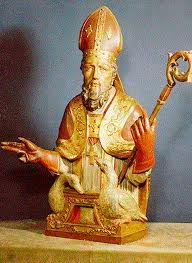
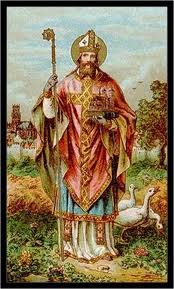
This great missionary died on Passion Sunday 809 while on a preaching tour, and he was buried at the Benedictine monastery of Werden. To avert a dispute, relics were taken to the monastery at Münster. He is variously depicted as a bishop reciting his breviary, or as a bishop holding a cathedral (as above), or a bishop with a swan on either side.
____________________________
******************************
Memorable Saying for Today
Thaw with her gentle persuasion is more powerful
than Thor with his hammer.
Thaw melts, Thor breaks into pieces.
~ Henry David Thoreau ~
******************************